SKU: 69655658819
buy an aloe vera plant online

buy an aloe vera plant online Aloe Vera

Sale price$22.85 Regular price$25.39
Save 10%

Pay in installments of $6.35 with ShopPay, AfterPay and Klarna

Shipping Estimate
USA
  • USA
  • CAN

Ships within 48 hours · Estimated delivery Jul 22 - Jul 27

Promo Codes Available:

For Your Every Summer RSVP, with Code: SUMMER15

Description

buy an aloe vera plant online Aloe VeraIntroducing the fabulous Aloe Vera plant also known as Aloe barbadensis 'miller,' it is also known as a medicinal aloe and burn plant. The Aloe vera plant is by far the most popular out of over 400 varieties of the Aloe genus. This incredible tropical succulent is not your average houseplant. It's a superstar known for its leaves, which hold a magical aloe vera gel for soothing sunburn and as a popular drink to help your stomach. This large Aloe vera

Introducing the fabulous Aloe Vera plant- also known as Aloe barbadensis 'miller,' it is also known as a medicinal aloe and burn plant. The Aloe vera plant is by far the most popular out of over 400 varieties of the Aloe genus.

This incredible tropical succulent is not your average houseplant. It's a superstar known for its leaves, which hold a magical aloe vera gel for soothing sunburn and as a popular drink to help your stomach.

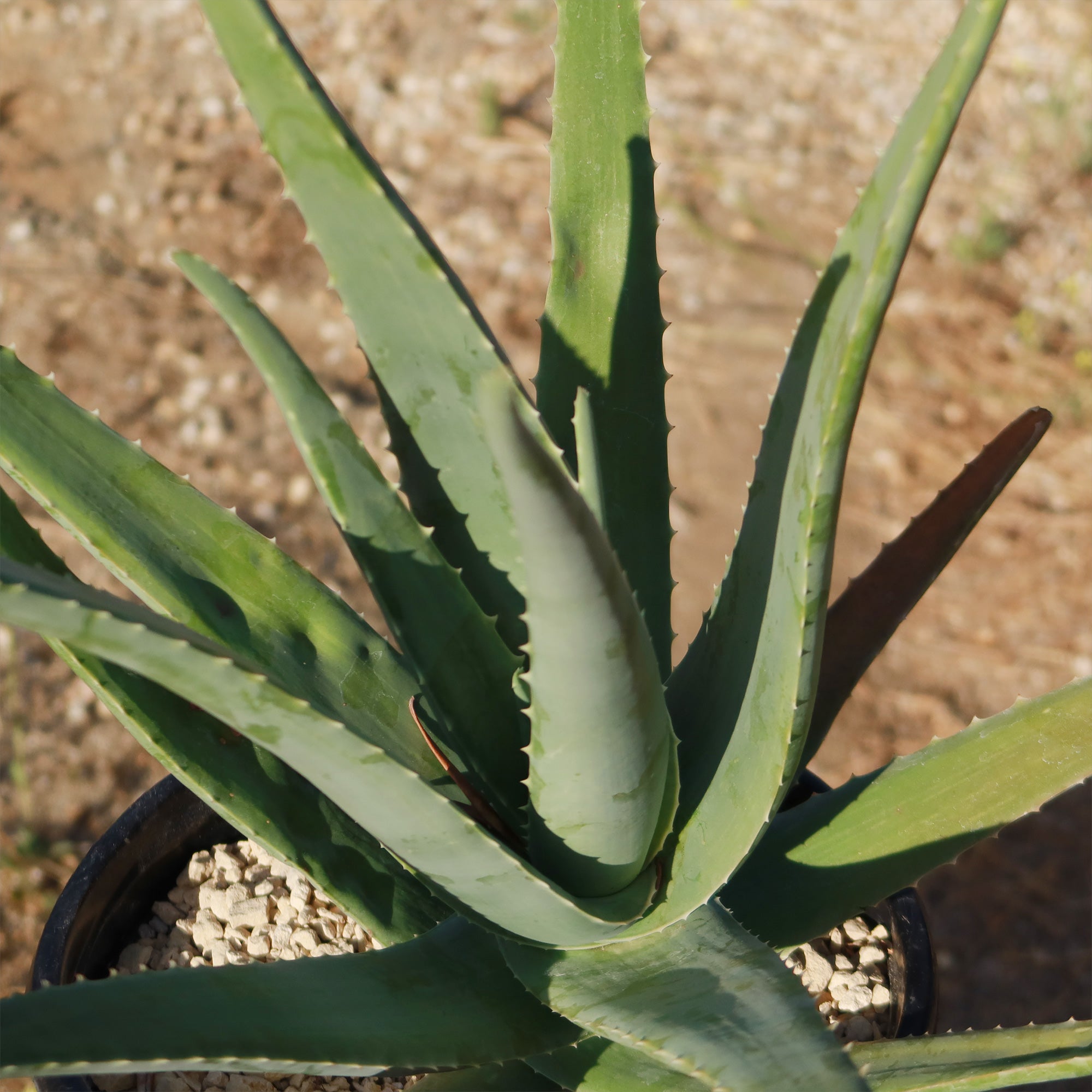
This large Aloe vera plant boasts fleshy lance-shaped grey-green leaves with small white teeth along the edges growing out from a starfish-like basal rosette. 

The edible aloe vera flowers burst into bloom in vibrant shades of yellow at the tips of their stalks when given favorable conditions. Only mature plants will yield flowers, so you'll have to wait at least four years to see an aloe vera bloom. However, in some growing conditions (especially hybrid plants), the flowers can sometimes appear with orange or reddish hues. 

This fast-growing succulent can grow into a large aloe vera plant up to 3 feet tall and 2 feet wide and even produce adorable pups that you can repot or share as delightful gifts with fellow plant enthusiasts.

How to Get Aloe Vera Gel from the plant to use on your skin

  1. Choose and Cut a Leaf: Select a large, healthy leaf from the bottom of the plant. Use a sharp knife to cut the entire leaf off at the base.
  2. Prepare the Leaf: Let the leaf sit upright in a container for 10–15 minutes to allow the yellow sap (aloin) to drain out. This sap can be irritating to the skin.
  3. Slice and Extract the Gel: For a small amount of gel, cut a section from the leaf rather than using the whole thing. Slice the leaf lengthwise to expose the gel. Use a spoon or knife to scoop out the clear gel.
  4. Apply or Store: Apply directly to your skin for soothing relief. Store extra gel in an airtight container in the fridge for a few days.

Aloe vera juice has many benefits for humans, this succulent rich in antibacterial, antioxidant, and anti-inflammatory properties, may enhance digestion, blood sugar levels, and oral health, although certain compounds, particularly aloin, may cause digestive discomfort and other side effects.

An aloe vera indoor plant is a great addition to any home, as it is easy to aloe vera care for and provides a variety of aloe vera benefits. 

According to the American Academy of Dermatology, Aloe vera has anti-inflammatory properties that can help in wound healing. It can also help to moisturize the skin and prevent peeling.

When and How to Water Your Aloe Vera 

As a desert dweller, watering the aloe vera succulent may be tricky, it may shrivel and die if given too little water, but it may also easily rot when given excessive water. So be careful not to overwater your aloe plantyou only want to give it enough to keep it from drying out completely, not drown it! 

A good rule of thumb is to water the Aloe plants deeply and then allow the soil to dry out completely before watering again. In the spring and summer, during the growing season, watering can be done once every 2-3 weeks.

During the winter months, when aloe vera is in a dormant period, it can be watered even less frequently. If you live in a rainy climate, consider planting aloe in gravel or stones. 

It is also important to note that aloe vera plants are sensitive to water quality. They prefer water that is low in minerals and salts, so it is best to use distilled or filtered water. Tap water can be used, but it should be left out for 24 hours before watering the plant to allow the chlorine to evaporate.

Light Requirements - Where to Place Your Aloe Vera Plant 

When growing indoors as a houseplant, place the aloe vera a few feet away from the south-facing window that receives plenty of sunlight, but it is important to avoid direct sunlight, as this can cause the leaves to burn. If the aloe plant is not receiving enough light, the leaves will start to droop and turn brown. In this case, it may be necessary to move the aloe vera plant to a brighter location. 

When planted outdoors, your Aloe plants need their daily dose of sunshine like a beach-loving teenager needs their favorite tunes!

They thrive on at least 6 to 8 hours of direct sunlight, soaking up those glorious rays with joy.

But wait, before you go dragging your aloe plant from its cozy shady spot into the blazing sun, be cautious. That sudden move can dry out your leafy buddy and leave it looking as yellow as a lemon.  

Now imagine you live in one of those cooler climates where clouds have permanent residency or if your home lacks these sunny windows altogether.

Fear not; you can use artificial lights – they're like little suns in bulb form! Hang them about one to two feet above your precious plant during daylight hours (that's roughly 16 hours per day) and watch it flourish happily amidst dim interiors.

Optimal Soil & Fertilizer Needs 

Aloe vera plants prefer well-draining soil that is a mixture of sand, perlite, and peat moss. It is critical to avoid soil that retains excessive moisture, as this can cause root rot. Instead, make or buy a well-draining potting mix, or ideally use our specialized succulent potting mix soil for aloe vera that contains 5 natural substrates and mycorrhizae to promote the development of a strong root system that helps your succulent to thrive.  

In terms of fertilizer, aloe succulents do not require a lot of nutrients. They can be fertilized once a year in the spring with a balanced fertilizer (NPK) of 5-10-5 in ratio. It is important not to over-fertilize the aloe plant, as this can lead to root burn. 

Hardiness Zones & More 

When grown indoors as a houseplant, aloe vera plants prefer a warm and dry environment. They thrive in temperatures between 60°F and 80°F. Aloe vera is a succulent, so it's adapted to arid conditions and doesn't do well in overly humid environments. Aim for a humidity level of around 30% to 40% for your indoor aloe vera plant.

In the United States, this is mostly an indoor plant, but if you live in southern Florida or Hawaii then you can cultivate it outdoors in USDA zones 9-11

Aloe vera can tolerate temperatures as low as 40°F for short periods, but prolonged exposure to freezing temperatures can damage or kill the plant. If you live in a colder climate, it's best to keep your aloe vera indoors or provide protection during winter months.

Aloe vera plants prefer dry air and do not require high levels of humidity. They can tolerate low humidity levels and do not need to be misted or placed in a humid environment. 

Wildlife - Aloe Vera Attracts the Following Friendly Pollinators

Aloe vera plants attract a variety of friendly pollinators, including bees, butterflies, and hummingbirds. These pollinators are essential for the reproduction of aloe vera plants, as they help transfer pollen between flowers, ultimately leading to the production of seeds. Additionally, these pollinators play a crucial role in maintaining biodiversity and ecosystem health.

Butterflies
Bees
Hummingbirds
Lady Bugs
Multi Pollinators
Other Birds

According to the ASPCA, the Aloe vera can be mildly toxic to pets and humans. It is rare but can occur if consumed in large quantities and can cause abdominal cramps, diarrhea, and electrolyte imbalances. It is important to consult a healthcare professional if you experience any adverse effects from consuming aloe vera.

How to Propagate Your Aloe Vera Plant

To propagate your aloe vera plant, you can separate the offsets or "pups" that grow at the base of the main plant. Gently remove these pups and plant them in their own pots with well-draining soil to encourage root growth. Water sparingly until they establish themselves, and place them in a sunny spot to promote healthy growth.

Aloe Vera: The Natural Sunburn Remedy


Aloe vera gel is known for its ability to moisturize the skin, it helps soothe burns and sunburns, as well as being known for its anti-inflammatory and antibacterial properties.

Aloe Vera is also rich in vitamins and minerals that are essential for healthy skin. It is best to use pure aloe gel extracted directly from an aloe vera plant.

To use aloe vera gel to soothe sunburns, cut off a piece of the large aloe vera leaf and open it to reveal the gel.

To maintain the aesthetic appeal of your aloe plant, it is advisable to cut off the entire leaf of the large aloe vera plant when cutting one. Just chop the leaf off as close to the main stem as you can. Cutting leaves from the base of the plant is always preferable. These leaves will be thicker since they are older. If you cut off the tip of a leaf, it will eventually turn brown at the tip because cut leaves keep their scars.

Key Takeaways

  1. Aloe vera is renowned for its medicinal properties, particularly its soothing gel, which is widely used for treating burns, wounds, and skin irritations. Its natural compounds, like aloin and acemannan, have anti-inflammatory and healing properties.
  2. When cut, aloe vera can seal its own wounds by producing protective latex, showcasing its remarkable survival mechanism in harsh environments.
  3. Aloe vera is not just a skincare savior; it also purifies indoor air by removing harmful pollutants like formaldehyde and benzene, making it a great addition to homes and offices.
  4. Native to arid regions, aloe vera thrives in minimal water conditions. It stores water in its thick, fleshy leaves, allowing it to endure prolonged droughts.
  5. The inner gel of aloe vera leaves is edible and used in drinks and food for its health benefits, such as aiding digestion, boosting immunity, and providing hydration. Always ensure proper preparation to remove any bitter or toxic compounds.
  6. The presence of yellow flower buds is a strong indicator of the edible variety.

The Bottom Line

Overall, Aloe vera is a popular plant known for its healing properties and versatility. It has gained popularity for its ability to help heal wounds, cuts, and burns, including sunburns. The gel inside the aloe vera leaves contains soothing and moisturizing properties that can provide relief and promote healing. In terms of care, aloe vera is relatively low-maintenance. It thrives in well-draining soil and requires moderate watering. It prefers bright, indirect sunlight but can tolerate some shade. 

A lot of people have a hard time finding large aloe vera plants, but here at Planet Desert, we regularly have large sizes in stock. Don't miss out on adding an Aloe vera plant for sale to your garden! Order now and enjoy its beauty for years to come. 

Shipping Notes
  • Free Standard Shipping on $100+ Orders to the USA.
  • Except Preorder products are shipped in 48 hours.
  • Delivery to the USA:
  1. Standard Shipping : 3-10 business days
  • If time is of the essence, please consider selecting expedited delivery for faster service.
Exchange/Return Notes
  • We offer a 30-day return/exchange service after receiving.
  • Final sale items are not eligible for returns or exchanges.
  • To process your return/exchange, please contact us at [email protected]
  • Please click here for more details>>> Return & Exchange Policy
SKU: 69655658819

Discover Niche Categories That Outsell buy an aloe vera plant online

Top-Converting Item to Boost Your Average Order

4.6 ★★★★★
Based on 10 reviews
Sort
Highest Rating
Newest First
Oldest First
Product Reviews
M
Verified Purchase
Martijn13Maart1970
Boise, US
★★★★★ 5
Unfortunately yet another one to add on the pile of writing books!
Format: Paperback
I say 'unfortunately another good book on writing' since I have been reading many books on the topic and each time I think I have read it all by now, pfff, but then another one like this comes along. But hey, it is fun to read about writing and especially if you get something useful and new out of it. Always worth the money. Why the accolades for this book? All the information on characters, plot, details etc, how they work and why they are important, is not new. You find them in many reading books, especially from Reader's and Writer's Digest series. I would especially recommend the books on plot and structure by James Scott Bell. Yet this book Wired For Story is not redundant, since it is unique in both the focus on the familiar subjects like what story is, the importance of details, details versus generics, how events affect a character etc. The approach of using brain science shows in a compelling way why all the stuff in the book (and for that matter, the classic theory on writing) is there for a reason, since it has evolved out of how we humans seem to perceive a story. Interesting though, a lot of rules like 'write about what you know' are shown to be myths. Of course, in the end it is you as a reader that has to decide what works for you, but you will find new things here and that is always good. If you are thinking about writing a story, this book can give you a very sharp focus on what to think about before you start. Or, like me, when you have a draft, and you want to get to the 'real story' behind it to come forward, this work gives you a very transparent way to get better clues as to what stays and what has to go. It is also entertaining and easy to read, so, all I can say is, yet again a book on writing you cannot afford to miss! I just added some extra information: I loved the humor and wisdom of the writer. She has worked for years reading manuscripts and she does know her stuff, and I liked her tone, which was both realistic but also fun! How many times have you read a reference work and actually had to laugh? But this book was also profound on many story issues. Many common writing rules are, as I said before, shown to be myths and more importantly, why this is so. I have read for instance so often that you should have some sensory info on every page, but, as I thought myself and I am not the only one: although this makes things more lively, it should only be there if the story would dictate it! The book has many more things like these. I have compiled a collection of notes I took from all the many many books on writing so I measure new books on writing in how much text I copied and pasted to look at again and this book has given me lots, so 5 stars and I hope we will see more of this author again! I also recommend the book by James Scott Bell on plot and structure which you can find here
WAS THIS REVIEW HELPFUL?YesReportShare
Reviewed in the United States on October 28, 2012
C
Verified Purchase
C. F. King
Belleville, US
★★★★★ 5
Great book
Format: Kindle
I have been an author for decades and published 4 books. I've been an editor for over a decade and this book is perfect for seasoned and new writers. It certainly made me take a new, long look at the latest book I'm busy with. I think it's great for getting one focused on the important points. I loved it. There wasn't too much about how the brain works to bore one or make it feel like a technical book on neuroscience. I found her writing style amusing and entertaining. I will definitely recommend it to all my clients and writing friends. There was nothing in the book I didn't know, but this book forces one to focus on the bigger picture. It doesn't matter how accomplished one is as a writer, one can always learn more. And I certainly did with this book. So, thank you, Ms. Cron. I saw the negative three or fewer star comments and can only think the commentators didn't see what the author was actually trying to convey. It's a classic lesson in the KISS method (keep it simple stupid) and I loved it. This isn't a full-on, in-depth analysis of every part of the craft of writing, as many seemed to expect, that would take 12 full books or more. This is also not only for beginners as some suggest. To them I would say, don't let hubris cloud your ability to write better--think beyond that--read the book again. I think the book serves as an excellent reference to keep us on track when we lose the plot, so to speak. Seasoned writers can get quite jaded and write almost on auto-pilot at times--not good. Thank you, Ms. Cron, for putting me back on track and making me excited to re-write and re-edit my latest book, my first YA fantasy, for the zillionth time. I was out of my comfort zone with this book and feeling a bit overwhelmed and unsure. Wired for Story has me fired up to go forth and do this. I highly recommend this book, especially for seasoned writers.
WAS THIS REVIEW HELPFUL?YesReportShare
Reviewed in the United States on January 26, 2018
R
Verified Purchase
robert lanier
Massapequa, US
★★★★★ 5
Quality writing information
Format: Paperback
A book that was fun to read and informative. I feel as though I have a better understanding of writing fiction now.
WAS THIS REVIEW HELPFUL?YesReportShare
Reviewed in the United States on February 11, 2026
R
Verified Purchase
Ron Mahon
San Leandro, US
★★★★★ 5
Thanks to a great new book ”Wired for story
Format: Kindle
I’ve written many books over the years, and published 40 or so. Once I started writing my first novel, I found out that all the old techniques just didn’t work. Thanks to a great new book ”Wired for story. The writer’s guide to using brain science. By Lisa Cron” Lisa studied and cataloged the works of several Neuro scientists. She explained all of that, plus how it applied to writing a novel. Better yet, she then shows us how to apply these techniques to where it counts. In addition, This changes the hierarchy of your novel. Ensuring that it’s focusing on what’s important to the brain. Using this new brain science, she proposes a completely new hierarchy of needs for your book. Moreover, the fact that the brain is trying to solve the problem of the protagonist. • “What happens” is the plot • “Someone” is the protagonist • The “goal” is what’s known as the story question • “How are he or she changes” is what the story itself is actually about. As counterintuitive as it may sound, the story is not about the plot or even what happens in it. Stories are about how we, rather than the world around us, change. The more your reader discovers the missing pieces to solving the protagonist's problem the more interesting if it is. It seems as the mind creates a mental stimulation of events described in the story. But he goes much deeper than that Details about actions and sensations that are captured from the text and integrated with personal knowledge from past experiences these data are then run through mental stimulation using brain regions a closely mirror those involved when people perform, imagine, or observe similar real-world activities. Haven’t you ever come home from a movie, reenacting that movie in your own mind? When the events of the story of filtering through the protagonist's point of view, allowing us to watch as she makes sense of everything. Seeing it in her eyes. This is not just like we see things. It’s that we grasp what they mean to her. Other words the reader must be aware of the protagonist personal effect on everything that happens. This is exactly where I fell apart on my novel is should be a first person third person. Lisa explains all these points of view, their advantages, and their disadvantages… My personal choices third person, omniscient. It also fixes another problem about tags. This technique is so powerful the third person doesn’t have to be bothered with he said;​ she said it’s so intuitive, it needs no explanation. It also settles a big dispute that I’ve always had the use of italic, quotes, and indented text. None are necessary. Some of the best examples that I’ve ever seen for show rather than tell. All the points that the author makes are demonstrated and explained with real examples from published articles. It’s like a five-year writing course that you can complete in three or four days. I bookmarked it extensively so that I can get back to those important points. Neuroscience also explains why social proof works so well. And a few hints on how to customize it, for your particular problem or opportunity. As a copywriter, one who writes advertising copy? I have long been aware of how to write directly to the subconscious mind. These techniques have been known for almost 100 years. We just didn’t know why they worked. Only that they did work. Thanks to Lisa for this fantastic book, I now know why they work.
WAS THIS REVIEW HELPFUL?YesReportShare
Reviewed in the United States on April 19, 2015
D
Verified Purchase
Doug Glassford
Boise, US
★★★★★ 5
Wowsers!
Format: Paperback
I purchased this book a few weeks ago expecting it to be pretty much like most of the other writing guides. I was not expecting to fall in love with it. I don't know if it appeals to me because of my ADD or the fact that many of the scientific studies Ms. Cron cites in her book confirms much of what I suspected was true in my dealings with people for over a half-century in sales and marketing. It helped fill in the gaps of how we as social creatures love to immerse ourselves in story on an ongoing basis... that we are hard-wired to socially share our thoughts and emotions through more than statistical data streams and cold hard facts. Her breakdown of the classic movie, "It's A Wonderful Life" literally changed my life by allowing me to see that George Bailey and I shared much in the way of misguided external goals blinding me to my true inner goals and motivations. I know this might sound like crap to some of you... but, I swear it is all true. In delving into what the protagonist of this movie wanted I discovered what I truly wanted and already had... I wanted to be unconditionally loved and accepted and I have all of that and more in my lovely wife. A black cloud of loathing at feeling like a failure lifted and I realize that if I died right now, I would do so a happy and fulfilled man. I know she did not write this book so I could pull my head out of a dark place, but, Lisa Cron, I thank you anyway. Other than my life altering epiphany, I would recommend this book because it is more than just another how to write better book... the information here will help anyone who wants to understand themselves better and the people around them either living or fictional. I can see where it will be a great help to writers who want to better write the stories that matter to them. I know it is helping me. I cannot recommend this book more highly than saying... buy it. It is worth every penny you'll spend on it. (For the record, I bought the paperback version.)
WAS THIS REVIEW HELPFUL?YesReportShare
Reviewed in the United States on December 10, 2012

recommand products